I was six years old when I learned that I had a brain tumor.
An MRI finally revealed what had been causing months of headaches, nausea, and problems with my balance. My parents had taken me to doctors twelve times over four months, but each visit was treated as an isolated event. Once they finally insisted on a scan, the tumor was visible almost immediately.
Doctors had seen the same symptoms in other children and the resulting patterns had been recorded in medical literature long before I became sick.A current systematic review traces headache, nausea or vomiting, and balance or coordination problems through decades of childhood central nervous system tumor literature. The HeadSmart campaign and the 2025 UK Childhood Cancer Diagnosis study show how long the diagnostic tail can remain even when a pattern is taught. A record can support recognition; it cannot guarantee a diagnosis. For four months, my parents knew that the explanations they were receiving did not fit the child they knew, but they had no way to connect what was happening to what medicine had already learned. Since then, that experience has shaped how I think about scientific progress. We often describe science as the production of new knowledge, but discovery is only part of the process. Knowledge also has to be preserved, organized, and made available to the people who need it.
A star chart. Three recorded stars labeled morning headache, nausea, and altered gait hang in a faint field, joined into a triangle. Beneath them, twelve small marks cross the chart as a low dipping track, labeled visit 1 through visit 12. The twelfth mark is larger and darker, and one gold line rises from it to the nearest star of the joined pattern.
Fig. 01.Twelve visits. The three signs were already on record, overhead, before the first visit. Eleven visits passed beneath them as separate marks; on the twelfth, my parents refused to leave without a scan, and the line rose. The pattern had been a constellation all along.
This problem exists partly because scientific knowledge is spread across papers, databases, institutions, and individual people. Publications record conclusions, methods, and evidence, but they do not always make clear which findings are considered reliable or what questions should come next. Researchers often reconstruct that understanding for themselves by reading widely, speaking with colleagues, and learning through experience. When they leave a laboratory or move to another problem, part of what they know can leave with them.
Vela is one way to organize more of this knowledge, so that a research area can be inspected as more than a collection of separate papers. It records specific relationships between pieces of knowledge rather than assuming that items appearing close together in a graph carry the same authority.
As We May Think
Science has become very good at saving information, but not always at saving the judgment around that information.Vannevar Bush put the problem in 1945: research results had grown beyond any one person’s ability to use them, and the means of navigating the record had not kept pace with the record itself. His answer, the memex, was a machine for holding the trails a reader made between documents, the judgment and not just the papers. As We May Think, The Atlantic, July 1945.
Writing was the first big step, as it meant that an observation could survive the person who made it. Take systems like the Library of Alexandria’s catalog, for example. Such catalogues helped readers navigate growing collections, as people needed some way to find what they were looking for. Later on, scientific journals made claims public and attributable, as they allowed researchers to share their claims across long distances.
Over time, editors and reviewers also became part of this system as they helped decide what should be published and what other researchers should pay attention to. However, the system still has a major weakness today. Most of the reason for this is that a paper preserves what its authors believed at one point in time, but it does not automatically show how the field’s understanding later changed.
In contrast to this, software handles part of the problem differently. With Git, developers have a shared record of a project’s historyGit keeps every committed state and the ancestry between them, so a later reader can recover what a project looked like at any point and what changed in between. Pro Git, Chacon and Straub. What it preserves is bytes and order, not whether a change was a good idea. and tests allow some disagreements to be settled against explicit rules. Science is much harder in this context because many important judgments cannot be reduced to a test. Researchers still have to make judgments about whether a result is convincing and whether it has held up over time.
The Protein Data Bank (PDB) shows what a more durable scientific record can support, as it gives structural biology a shared, machine-readable collection that later work, such as AlphaFold,The Protein Data Bank has been openly accessible since its founding in 1971 and now holds well over two hundred thousand released structures. Jumper and colleagues describe the training corpus in the AlphaFold paper. could build on. Despite the success of this, the PDB does not fully preserve every change in how researchers interpreted those structures or how confident they were in the claims built from them. This is, at its core, an infrastructure that is currently missing in today’s scientific realm. As experiments become cheaper, science needs a clearer record of which results researchers have checked, which ones they no longer trust, and why.
This problem becomes much more important once the cost of making a new scientific attempt begins to fall. Researchers have always chosen which questions to pursue partly based on the time involved, because an idea that initially seems simple may still require weeks or months before it becomes something another person can examine. A researcher therefore has to decide not only whether an idea is interesting, but whether it is worth spending that amount of time investigating, and a large amount of science depends on the people who are willing and able to make that commitment.
In June 2026, an exercise called First Proof put ten problems from active mathematical research to four AI systems, which returned thirty-nine proposed solutions.The First Proof Second Batch report publishes the problems, outputs, logs, human solutions, referee reports, and methodology; thirty mathematicians supplied at least two expert readings for every submission. A Harvard account describes the range of correct, opaque, uncited, and wrong submissions. Some of the submissions were new and correct, while others were difficult enough to understand that referees spent hours working out what the arguments were actually claiming. It was still very far from a situation in which AI systems were producing mathematics that people could no longer understand. Its arguments remained within human reach, and qualified mathematicians could still determine whether the proposed solutions were correct. But even at this scale, thirty-nine proposed solutions required at least seventy-eight expert readings. If the number of submissions grew from thirty-nine to hundreds or thousands, the limiting factor would no longer be the number of possible solutions the systems could produce. It would be the number of experts who had enough time to read them carefully.
A flow chart of review pressure. Thirty-nine open rings form a column on the left. Two fine strands leave each ring and cross as a combed sheaf to thirty filled marks representing the mathematicians who judged the work. One proposal’s ring, its two strands, and its two referees are gold.
unfold the review pathsfold the readings away
Fig. 02.Absorption pressure. Thirty-nine AI proposals, each assigned to two or three expert referees, judged by thirty mathematicians. Each open ring shows the minimum two acts of expert attention; the gold pair follows one proposal to two of the people who carried it.
Ted Chiang imagined a much more extreme version of this imbalance in “Catching Crumbs from the Table.”“Catching Crumbs from the Table,” Nature, 2000; collected as “The Evolution of Human Science” in Stories of Your Life and Others. In the story, metahumans make discoveries that ordinary humans can no longer fully follow, leaving people to study the consequences of work they do not completely understand. We are nowhere close to that situation, but the story is a useful analogy in how producing a discovery and being able to use that discovery are not the same thing.
This prompts another question: once a result has been reviewed, what exactly should the scientific record preserve? Generally, a check can verify only one narrowly defined condition while the meaning of the result still depends on how far that finding can reasonably be applied, and, simultaneously, judging how much evidence supports a claim is often less straightforward than it seems. Even in mathematics, a proof checker can only verify the formal statement it receives. If that statement leaves out part of the original claim, the proof may still be valid even though it no longer establishes everything the researchers thought it did.In 2026 the authors of “Fel’s Conjecture on Syzygies of Numerical Semigroups” translated a research conjecture into Lean and released the checked artifacts in a public repository. Kernel acceptance establishes validity against the formal statement, libraries, and environment. It does not establish that the formal statement matches every intended part of the informal conjecture.
A frontier begins by separating five acts that scientific work often blurs together:
Produce. Preserve. Check. Decide. Reuse.
A researcher, laboratory, or agent produces a bounded piece of work. A record preserves its claim, artifacts, evidence, conditions, and caveats. A named verifier checks one stated property. A community decides whether the work changes its accepted starting point. The next researcher continues from that state.
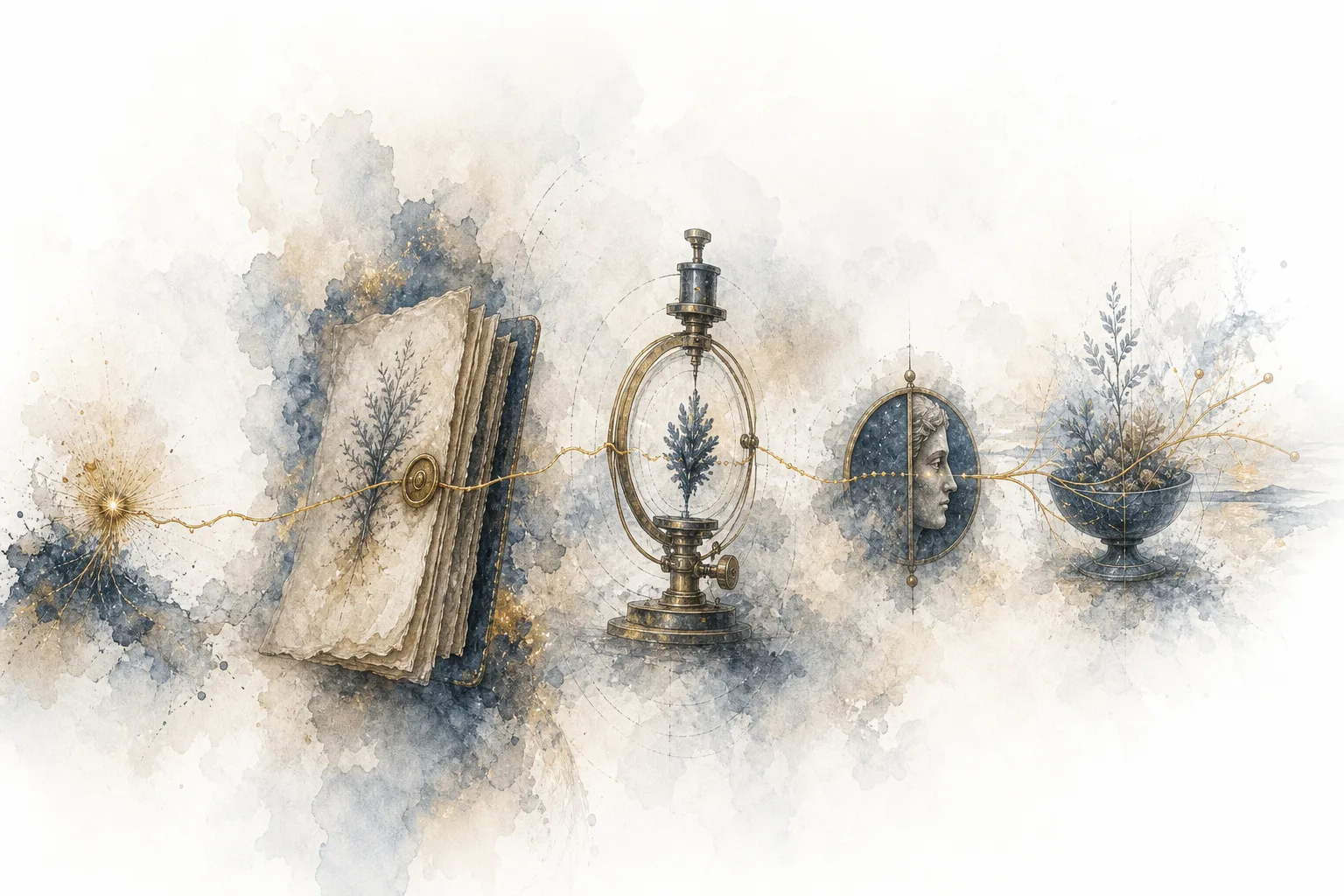
Each act has a different owner and scope. A Lean kernel checks a term against a formal statement and environment. An instrument checks a physical quantity under calibration and sampling assumptions. Neither check supplies a scientific verdict.
A horizontal chain of revisions r15, r16, r17, and r18, joined left to right. A dashed cinnabar line labeled referee correction 2026-05 drops from above onto r17, which is crossed with a cinnabar seam and labeled superseded, kept. A single gold segment continues the chain from r17 to r18, drawn as a gold ring labeled current starting point. The chain continues past r18 as a short dashed line. Six small records hang below r17 in two branches, each wearing a dashed amber review ring, with the amber note 6 reopened for review.
Fig. 03.The starting point, moved. The fel-syzygy record as a chain of revisions. A referee correction drops onto r17; the statement is struck but stays on the chain, and the one gold stroke carries the community’s starting point forward to r18. Six dependents hang off the corrected revision, ringed amber for review, and the chain runs on dashed. Nothing is erased; the starting point moves.
Olbers’ Paradox
Scientists often talk about taste as a private virtue, although in practice it determines which uncertainty deserves the next experiment or year of attention. Generally, the people with the strongest taste are the ones who have read enough to notice a connection others miss, or to remember that a promising idea was already tried decades ago. Much of that judgment stays with the people who developed it.
Olbers’ paradox asks why the night sky remains dark when there are so many stars. Science can feel similar in a loose sense.The paradox is named for Heinrich Wilhelm Olbers, who posed it in 1823, though the question is older. The modern resolution turns on the finite age of the observable universe, with the expansion of space reddening what does arrive. NASA summarises the reasoning in its account of the expanding universe. The literature contains more findings than any person could follow, yet many of the connections between them remain difficult to see because the reasoning still sits inside institutions or individual people. A shared record could make more of the material behind that taste available so that people working years apart could begin from the same frontier.
I think science therefore needs a more public and usable account of what is known. I use the term public frontier to describe that shared layer of knowledge: the findings a community is prepared to build upon, the limits of those findings, and, most importantly, the questions that remain unresolved. This becomes especially important if AI systems are going to take on more scientific work. An AI system may be able to analyze evidence or propose new approaches, but it can only build on knowledge that has been made available in a usable form. It cannot recover a connection that was never recorded or understand why a community trusts a result if the reasoning behind that trust remains scattered across institutions and individual people.
Each frontier belongs to a named community with a bounded scope. Its maintainers speak for that record.
A laboratory may accept a synthesis on its instruments while a standards body waits for durability data. A manufacturer may reject the process because it cannot scale safely. Each group can publish what it accepts, who may change the record, and how another person can challenge a decision.
Their frontiers may disagree. The records should show whether they disagree about the question, the evidence, the check, or the judgment. A critic can inspect the history, argue for a correction, or maintain a competing frontier.
A community needs a charter that names who may decide, how challenges work, and how maintainers are replaced. It also needs a visible queue. The frontier should show proposals waiting for review instead of presenting silence as rejection or consensus.
A constellation sits above these plural records as a chart. It gathers related frontiers or findings around a question while preserving who drew each line and which authority governs each source. It supports navigation. It does not merge standing or create consensus.
The record must also show lineage. Ten papers may analyze the same patient cohort. Two laboratories may share one assay and one failure mode. Without those links, repetition can look like confirmation.
Vela can preserve and transfer a research community’s knowledge without relying on private explanations from the original team. It creates a public record of what the field accepts, why it accepts it, which earlier findings new work depends on, and how corrections affect later projects. I would test it first in a small area of mathematics or machine learning where mistakes are easy to identify.
Acceptance stops short of action. A hospital may inspect a corrected frontier, but clinicians still have to notice the change and alter practice. Teams adopt new standards through training and trust.In “Slow Ideas,” Atul Gawande contrasts rapid communication with the slower work of changing practice through trusted human contact. A frontier can make a correction visible; institutions retain authority over clinical action.
The simplest example of this would be to consider an outside researcher who has never met the original maintainers. She should be able to open the record, understand the field’s current position, submit a new result, and see which earlier findings it relies on. If one laboratory reports a failed synthesis, the next laboratory should change its first attempt.Raccuglia and colleagues trained a model on unsuccessful vanadium-selenite syntheses recorded in laboratory notebooks. In prospective tests its chosen conditions produced the target class in 89 percent of attempts against 78 percent under traditional human selection, reported in Nature in 2016. The archive stayed inside the group that produced and interpreted the failed runs. If outsiders still need the original team to explain missing context, or if Vela adds more work without improving the handoff, then the system has failed. In the case of a successful attempt after a correction, another outsider should be able to see which projects need to be reconsidered and choose what to work on next without asking for a private explanation. The same should be possible for an AI agent or a separate software system. In these contexts, Vela can be compared to a normal repository or review article.
A failed synthesis only helps if the laboratory kept its conditions and outcomes. “No crystal formed” might count against a hypothesis, reveal a temperature boundary, or show that a freezer failed. A reviewer still has to choose among those readings.
A diagram in two halves. Above, six stations joined by a gold line into a loop: clone an exact state, read the claim and its caveats, run the named checks, see what is open, propose a correction, and rebuild from the same history. A return arc runs beneath them back to the first station, marked as where the next person begins. The loop is labelled as demonstrated in small mathematical frontiers. Below, three dashed lines leave the loop and end in open rings, labelled independent adoption, empirical extension, and durable stewardship, under a heading reading unproved.
Fig. 04.The test it can fail. Six things an outsider who has never met the maintainers must be able to do, drawn as the loop they form. Vela has demonstrated parts of this loop in small mathematical frontiers, where exact checks make mistakes easier to expose. Three directions leave it dashed: independent adoption, empirical extension, and durable stewardship remain unproved. Naming them is what makes the claim testable — measure how long an outsider needs to find a relevant prior attempt, follow a correction into dependent work, and count proposals waiting without review.
Science, the Endless Frontier
The same limit returns at a larger scale once machines begin producing a large share of humanity’s most valuable output. The constraint is not how much they can produce, but whether what they produce can be built on.
We already see part of this problem in science as we usually see a large amount of research published without becoming something that other researchers can easily build upon. This is where Martin Nowak’s argument about cooperation becomes useful. His point is that cooperation does not continue on its own, as it relies on a mechanism that makes it possible for people to contribute to something larger than their individual work.“Five Rules for the Evolution of Cooperation,” Science, 2006. The rules describe when cooperation is evolutionarily stable in a population. The analogy here is to the requirement, not to a claim about what motivates scientists. In science, that mechanism should include verification and a way for later researchers to understand what earlier work actually established. The goal for the future of the technological and scientific community, therefore, should not be to create billions of lines of code or scientific outputs that no one reads, as doing so does not create much meaningful progress. It should instead aim to make scientific knowledge usable enough that a community can keep building on it together.
This is also why the frontier has to remain public. Its memory cannot depend on one lab or private firm continuing to operate or on the original researchers remaining available to explain what they meant. For me, this is much more than just an abstract problem about scientific infrastructure. When I was six, I saw doctor after doctor for four months before the cause of what was happening to me was finally found. I cannot know whether a better shared record would have changed my experience, and medicine will always contain uncertainty. What I do know is that another six-year-old should have a better chance of benefiting from what other doctors, researchers, and patients have already learned. That child should not depend entirely on whether one person happens to remember the right connection at the right time.
None of us starts from nothing as we receive knowledge from people we will never meet, including those whose failed experiments narrowed the search, and children whose symptoms helped someone recognize a pattern before mine. We work with that knowledge for a while and leave it for the people who come next, so long as we make sure that others can actually use it.